做自己,因为别人都在做自己。
– Oscar Wilde
这是我新博客的第一篇文章。我刚开始写这个新博客,因此请继续关注。在下方订阅,以便在我更新新文章时您会收到通知。
MCS.923: Critical Methods in Media and Cultural Studies
做自己,因为别人都在做自己。
– Oscar Wilde
这是我新博客的第一篇文章。我刚开始写这个新博客,因此请继续关注。在下方订阅,以便在我更新新文章时您会收到通知。
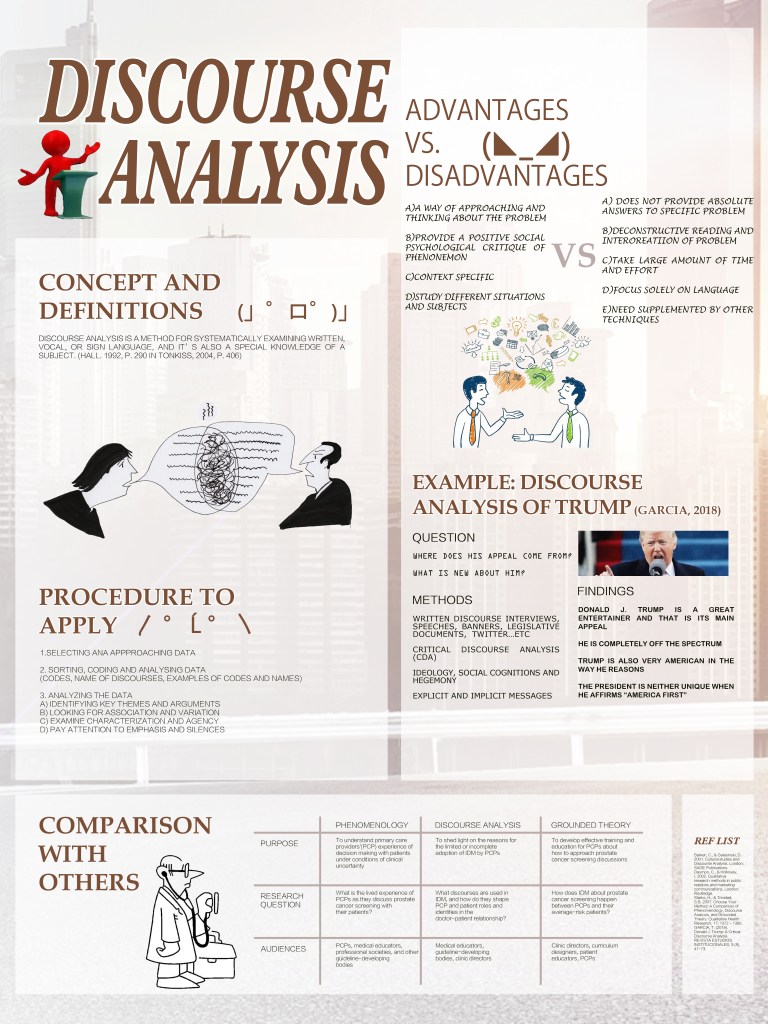
In “Rethinking Digital Anthropology”, Tom Boellstoff (2012) mainly discussed the complex relationship between virtual and actual, and the importance to understand the stake of the online world for the whole society. The starting point of his research is a common misunderstanding on the studies relate to virtual world that fusing the virtual and actual into a single domain.
According to Tom (ibid), one analogy of digital anthropology is virtual anthropology, although they are not exactly equal, as digital anthropology provide a specific methodology to study online culture and to point out the inner link between virtual and actual in social practice. Tom Boellstoff suggests that both blurring and fusing of online and offline are partial views. One example here lays in online computer games, where players are immerse in a virtual world while their identification of the world and themselves are based on the real world. So virtual world is not merely a derivative of the offline. Boellstoff (ibid) do insist that we cannot treat virtual world as a distinct part from “the rest of the world”, and with the development of technology, online socio-cultural issues are even not marginalized problems in today’s anthropology studies as more and more people join in and the increasing social behaviors taking place on the Internet.
Digital anthropology is developed from traditional anthropology, which is also based on observation, and is always used to study the communities that never be real understood by the dominant culture. But it is obvious that researchers are facing a different situation when the main research field move to online. Things like the means of materials, the way to access participants, and the point of taking field notes will change. While a superiority that digital anthropology enjoys is information which post online like video, blog and twit, can be watched or read repeatedly, while in the physical world, events are one-off, if researchers didn’t notice and record it at the first time, many details might be ignored.
Compared with visual analysis, digital anthropology is suitable for more complex research contexts, as the research method of anthropology is more flexible and changeable, always containing various materials including dialogues, photos, behaviors and so on, which is far more than visual studies. However, it is a balancing-art for anthropologist to maintain an appropriate distance with their participants, as they should be both an insider and an outsider to the community they study.
Reference:
Boellstoff, T. (2012). Rethinking Digital Anthropology (pp.39-60). In H.A. Horst and D. Miller (eds.) Digital Anthropology. London: Bloomsbury Academic.

Digital technology has changed the lives of millions people’s life hugely for decades. Hence, Tom Boellstorff (2012) regards digital anthropology as the analytic target. In this paper, he treats the digital as a methodology instead of an object of study. Boellstorff makes it clear that ‘ Digital anthropology is a technique, … It is an approach to researching the virtual that permits addressing that object of study in its own terms.’ (Boellstorff 2012: 40). And the basic method is participant observation which is universally used in digital ethnography or ethnography. The benefit of this method is to emphasize the deep interaction between scholars and cultural participants and co-construct the meaning.
In the first part, Boellstorff provides us with ‘dubbing culture’ which is developed by himself to research into Indonesian term gay to explain deeply a conception that put forward by the British anthropologist Edmund Leach. He justifies that ‘Our task is to understand and explain what goes on in society, how societies work.’ ( Leach 1961 :6-7).
With the aid of the digital, the distinction between the virtual and actual can avoid of blurring. To prove his conception, Boellstorff insists the existence of the gap by examining the online virtual world known as Second Life in order to argue against the mistaken assumption that virtual/online worlds and the actual/offline world are fusing into one domain.
In conclusion, Boellstorff’s research enlightens us to reconsider the internet-mediated sociality. People use internet with different purpose. When doing digital anthropology research, it is necessary to take the social practice situation of users into consideration and keep cognitive framework in mind. This paper triggers self-examination of the openness and limitations of digital anthropology and more challenges from technology may be faced in the further research.
Reference
Boellstoff, T. (2012). Rethinking Digital Anthropology (pp.39-60). In H.A. Horst and D. Miller (eds.) Digital Anthropology. London: Bloomsbury Academic.
Leach, E. R. 1961. Rethinking Anthropology. In Rethinking Anthropology, 1-27. London: Robert Cunningham and Sons.
By Weican Feng
The two readings discussed in this paper is all related to the digital ethnography, in which the study in Boellstorff (2012) was focused on explaining the difference between physical reality and digital unreality, to explain the benefits of digital anthropology and provide theoretical framework for understanding the digital anthropology. While the study of Boellstoff (2016) was focus on the ontology turns to theorising the digital real. It mainly focused on the ontology and epistemology of the digital ethnography.
Both of the two studies use extensive literatures related to the digital anthropology and anthropology for their research. Both of the two studies Boellstorff (2012) and Boellstorff (2016) applied literature review researches based on systematic analysis for explaining the theoretical and methodological foundation and applying the digital anthropology method. Thus, it can be seen many direct quotation in the two papers for expressing other scholars arguments to support, or use as counterargument for their discussed theme.
The choice of digital anthropology should attribute to the increasingly use of internet and digital technology in human world, it become the most effect way to observe people and understanding their behaviours. As Boellstorff (2012) stated, for studying people behaviours, interview or questionnaire could also be used, but those method more focus on the interaction and communication with participations rather than using the digital anthropology to observe the participations.
Compare with the visual analysis that focus on the image and photography, the digital anthropology could be used to understanding the difference and similarities between online and offline live of people through participation observation. Generally speaking, the visual analysis only include the secondary materials (photography) which study the historical things, while the digital anthropology study the current issues, involving human beings’ participations in the research process by observation, both of them are widely used method for media and cultural studies (Hyman, 2009).
Same with the readings in visual analysis, in the Boellstorff (2012) and Boellstorff (2016), author have been involved in the research and they put themselves into the text, for Boellstorff (2012), it use its three day digital life to explain how to use the digital anthropology for understanding human beings; for Boellstorff (2016), it use other scholars’ studies with its personal judgements in the research for explaining the methodology turn of the digital anthropology. By such writing style, it could use personal case to demonstrate their arguments and use their own experience to show how digital anthropology works for media and cultural studies.
The digital anthropology could be used in many media and cultural studies, especially to study the digital consumers’ behaviour for identify the potential for product innovation, to test things from behavioural insights through internal communications throughout the observation process in digital anthropology application (Silverman, 2000). It is quite useful in contemporary media and cultural studies and it seems that people is no longer get rid from the digital platform, the digital reality also become the physical reality currently.
References
Boellstorff, T. 2012. “Rethinking Digital Anthropology.” In Digital Anthropology, ed by. Heather A. Horst and Daniel Miller. 1st ed. 39-60. Bloomsbury Academic.
Boellstorff, T. 2016. “For Whom the Ontology Turns: Theorizing the Digital Real.” Current Anthropology, 57 (4): 387–407.
Hyman. S, J. 2009. ‘Getting Started’ in How to do Media and Cultural Studies. London: Sage.
Silverman, D. 2000. Doing Qualitative Research: A Practical Handbook. London: Sage.
by huijie wang
Tom Boellstoff (2012) stated in his book on digital anthropology that this is not a borderless digital concept, it opens a door to a more powerful conceptual framework for understanding the constant common forms an exponential relationship between virtual and real. Digital anthropology is actually an anthropological development. Ethnography is considered a method of practical research, which invites researchers to use various methods (video, text, interviews, etc.) to live and research in digital, physical and sensory environments. The Digital Ethnographic Society often has indirect contact with participants, instead of being directly present. We may digitally track the behavior of others, or they invite us to join their social media activities to observe their behavior (Pink, 2016).
When digital anthropology is used as a research method, it pays more attention to the whole research process and the involvement of researchers. Therefore, the advantages and disadvantages of digital anthropology are very obvious exposed.
1. The method of “participation in observation” is the most commonly used method in digital ethnography or ethnography. It provides ethnologists with insights into the development of practice and meaning, and enables researchers to identify cultural practices and beliefs that are not understood in research design. The most rare is that this method can get more true and accurate answers than official responses (Boellstoff, 2012). In contrast, the observation method takes a long time because researchers cannot integrate into a community in a short time (Rosaldo 1989, p.25 in Tonkiss, 2012, p.55). Obviously, for some surveys that are eager to know the results, this method is difficult to use.
2. The results of ethnographic or digital ethnographic research usually appear in the form of essays or articles, but whether they are interviewed alone or participated in observation they face the same problem-subjectivity and objectivity. Because when using digital anthropology as a research method, investigators often choose to combine blogs and other text analysis for “ethnographic research” (Boellstoff, 2012) while conducting interviews and observations. But in this process, researchers usually don’t know which cultural customs they will observe in their research, and there will be great risks and uncertainties in the process of network recording. Therefore, many times ethnographic research is separate from the researchers themselves.
3. Even so, on the one hand, one of the biggest advantages of ethnographic methods is that Boellstoff (2012) believes that researchers can apply them to specific field environments at specific time periods, which is very convenient in research. On the other hand, since the use of ethnographic methods usually involves re-editing and demonstrating materials and combining analysis with participants’ observation diaries, such a process of repeated confirmation and discussion is sufficient to prove that this is a very scientific And rigorous research methods.
Interestingly, ethnography and visual analysis can be complementary in some ways. First, from the comparison of the understanding of visual analysis provided by Roland Barthes (1981), in addition to the subjective understanding of the work by photographers or creators, it is difficult to ensure that everyone can fully understand the work. And the rigor of ethnography can just make up for this shortcoming. Secondly, Visual analysis can quickly analyze the content of hundreds of photos and give judgments in a short period of time, which also contrasts with the shortcomings of wasting time in ethnography.
Generally, ethnography is a very effective and difficult research method, but as long as it can be used well, it will bring unexpected results to many researches.
Reference:
Barthes, R. (1981). Camera Lucida. New York: Hill and Wang.
Boellstoff, T. (2012). Rethinking Digital Anthropology (pp.39-60). In H.A. Horst and D. Miller (eds.) Digital Anthropology. London: Bloomsbury Academic.
Pink, S. (2016). Digital ethnography. London: Sage.
In the book Camera Lucida (1981), Roland Barthes interprets images base on ontology approaches, in which he asserts that photographs separate consciousness from the substance and transforms subject to object. To further explain that, Barthes introduces three concepts:
– the operator (the photographer)
– the spectator (ourselves)
– the spectrum (any eidolon emitted by the object) (9)
They are actually three dimensions to understand a photograph, for example, from the operator’s perspective, he is using a silent way to “speak out”, so the emotion, belief, status of him, the environment around him, and the historic period he was in…all of these things are able to be considered as additional conditions when we try to understand the photograph. But the fact is, everyone might interpret one picture from a different way, as people usually tend to understand a new thing through the most familiar way, or say, based on their own experience. This is perhaps the charm of many famous paintings, as everyone, every era can interpret the masterpieces differently by their own sense of agency. But this, in turn, reveals the most obvious shortcomings of visual analysis. The variety and flexibility of explanation will often reduce the accuracy of the interpretation. And it has led to the vague conception of visual analysis.
We therefore can see some people believe that compared with language and texts, image is a rudimentary system, while others consider that signification cannot exhaust the image’s richness(Barthes, 1999). Different from discourse analysis, visual analysis is a semiotic approach which usually includes a series of discontinuous signs. The clues that images give can be seen from two levels: denotational signs (what is actually shown in the image) and connotational signs (the associational meanings). In most cases, the meaning behind the apparent codes is the key point to understand the image. So for the audience, the question like “what you think you see” and “what does not be shown” is more important than “what you see” and “what has been shown”.
Reference:
Barthes, R. (1981) Camera Lucida. New York: Hill and Wang.
Barthes, R (1999) Rhetoric of the image, Visual culture: the reader. (pp. 33-40)
By Anqi Weng
Discourse analysis is a general term for a number of approaches to analyze written, vocal, or sign language use for any significant semiotic event. It’s generally agreed that words are the beginning of human civilizations. What’s more, different peoples express things differently. In this situation, using discourse analysis under different cultures can make it easier for us to understand the things in different cultures.
However, compared with visual analysis, discourse analysis is not direct enough to catch the message. Visual analysis is a frame which helps us to understand artworks. In addition, visual analysis can base on shapes, colors and patterns to help people to understand the meaning of pictures. It is more intuitional for audience in understanding the real meaning of the picture.
Weican Feng
This paper mainly discusses 8 topics from both aspects of news press and TV stations. The authors use quantitative methods to collect ample cases to find there may exist some different expression in various media content, such as special terms or numbers. Here are the topics:
When comparing the cases of news in the press and on the TV, some expression difference may be presented obviously. For example, when it comes to the asylum, how to define these groups of people may mirror the ideology or worth value of different media intermediary. The term ‘illegal immigration’ or ‘illegals’ occurs usually on the TV news broadcasts but not featuring at all in ITV Lunchtime News. However, this term is frequently used in the Express and other three private press from these collected cases, whereas from where UN stands it prefers to call these refugees as ‘undocumented immigrant’.
As the authors mentioned, ‘Emphasis on numbers was the strongest theme in the TV sample.’ (Greg, Briant and Donald, 2013:104). However, ‘The press sample was largely characterised by the use of superlatives.’ (Greg, Briant and Donald, 2013:106). They may focus on distinct points to gain the more attention from audience. Because in nowadays, according to the theory of ‘circulate of culture’ which is put forward by Stuart Hall, these production is deemed to be consumed. And audience is the target. Thus, different media methods use different way to show their worth and maybe this is the reason why TV station and news press do not select the same expression.
From the module, discourse analysis is a method for systematically examining talk and texts. Discourse analysis is also a ways of representation-a special knowledge of a subject (Hall 1992, p. 290 in Tonkiss, 2004, p. 406). One of the main usage of ‘discourse’ is discourse as ‘social action and interaction, people interacting together in real social situations’ (Fairclough, 1995, p.18). And the other one is ‘a social construction of reality’, a form of knowledge’ (Fairclough, 1995, p.18). Discourse analysis is an analytic technique rather than a theory, and its popularity has arisen from the growing interest, starting late in the last century, in qualitative research and ways of analysing the data it produces. And when you use discourse analysis, you might focus on:
Conducting discourse analysis means examining how language functions and how meaning is created in different social contexts. It can be applied to any instance of written or oral language, as well as non-verbal aspects of communication such as tone and gestures.
Reference
Philo, Greg, Emma Briant, and Pauline Donald. 2013. “Case Studies of Media Content, 2011.” In Bad News for Refugees, 87–130. London: Pluto Press.
Tonkiss, Fan. 2004 “Discourse Analysis.” In Researching Society and Culture, ed by. Clive Seale, 405–423. Thousand Oaks, CA: Sage.
Weican Feng
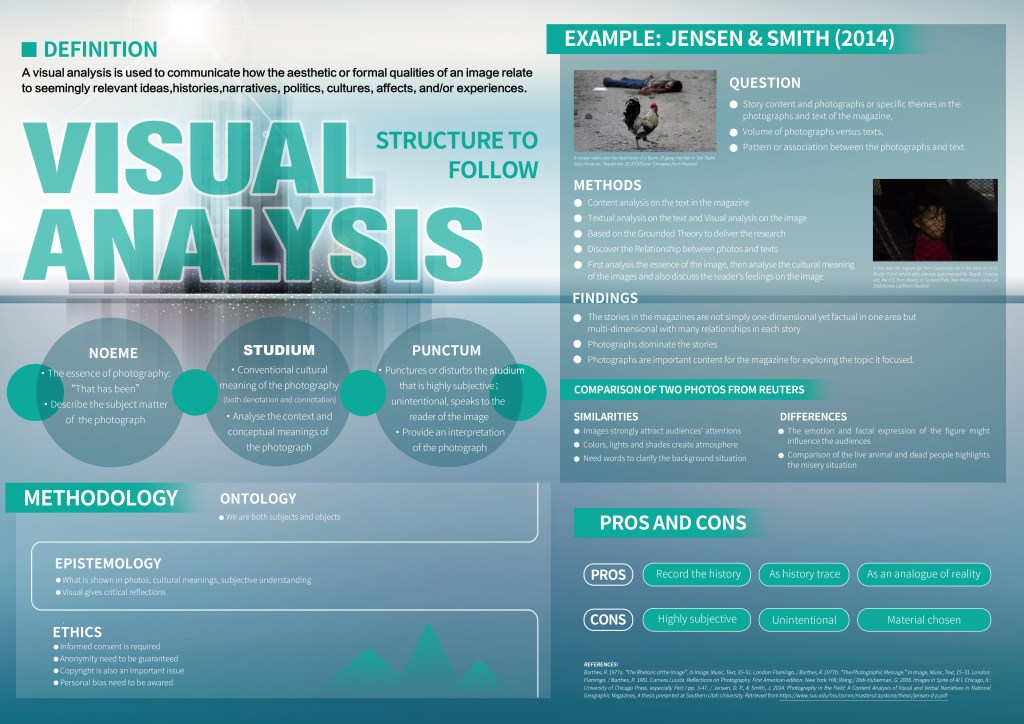
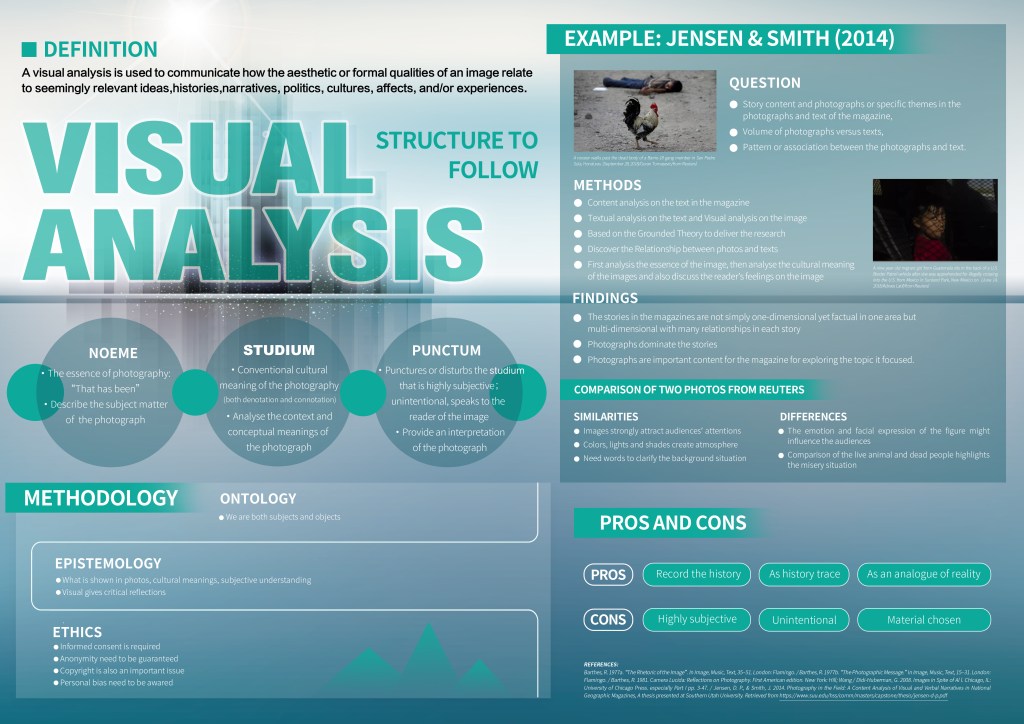
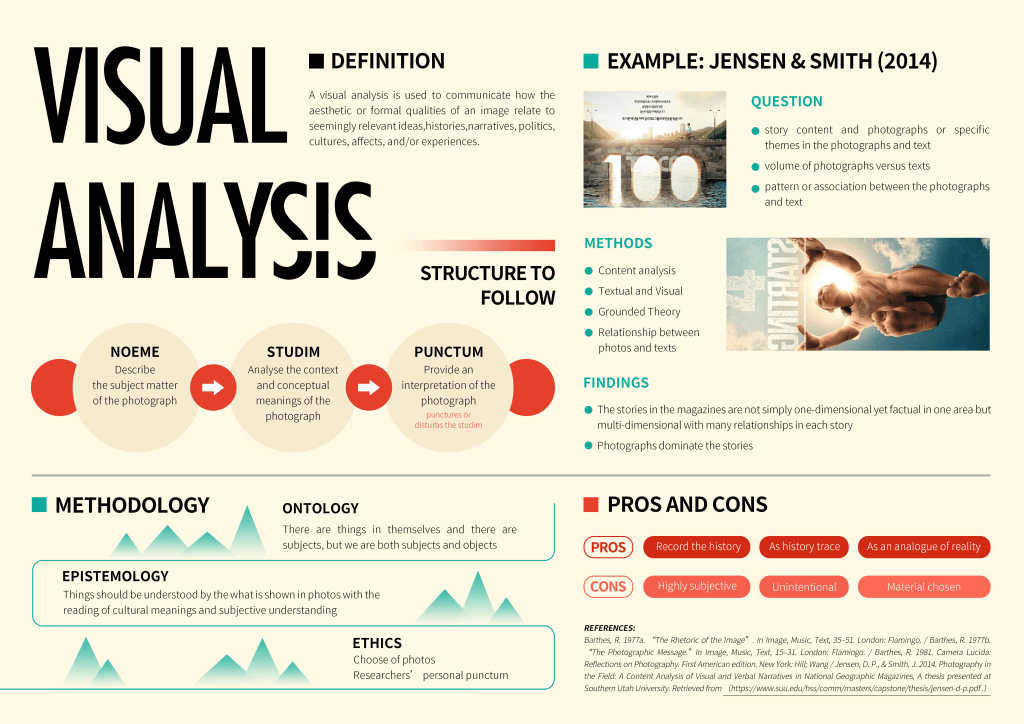
Visual analysis is used to convey the aesthetic or formal qualities of an image. It is relevant with what may happen in the life.
According to Barthes’ (1977a) suggestion, ‘the photograph analysed offers us three messages: a linguistic message, a coded iconic message, and a non-coded iconic message’. And the press photograph is a message which is formed by a source of emission, a channel of transmission and a point of reception’. Although the emission and the reception of message are relatively unchanging, the message itself is certainly different. This metaphor is really impressed on me. Everyday we accept all kinds of information actively and passively. Sometimes I do not notice that these images may change my perception of the world potentially. Some images may touch my heart when they express essential and inner layer of what may have happened in my life or what I have never experienced before. For example, I live a relative peaceful life, whereas Syrians have to struggle for their life. When the images present the living situation of them, the belief of ‘peace and love’ perhaps becomes more universal.
And when we analyze the photograph, Barthes(1977b) indicates that it can be found that the structure of the photograph is not isolated. The linguistic accompanies with the image to express the message. Hence, the content of the photographic message is the literal reality. But on the other hand, Barthes explains that the image is not the reality and the message is without a code. Besides, he insists that ‘the linguistic message is thus twofold: denotational and connotational.’ With only image signs, different people absolutely hold different opinion. Linguistic message may assist to give instructions. ‘In other words, the sign of this message is not drawn from an institutional stock, ,is not coded, and we are brought up against the paradox of a message without a code’ ( Barthes, 1977a: p35).
Reference
Barthes, R. 1977a. “The Rhetoric of the Image”. In Image, Music, Text, 35–51. London: Flamingo.
Barthes, R. 1977b. “The Photographic Message.” In Image, Music, Text, 15–31. London: Flamingo.
Discussion of the Key Readings in Visual Analysis
In the reading under the discussion, visual analysis method has been used. The three key readings in the visual analysis include Barthes (1977a), Barthes (1977b) and Barthes (1981) all focus on the analysis and understanding of image and photography. Those researches all focus on the understanding of photography and the related information under the photography, that all belongs to the semiological analysis of visual phenomena. For instance, Barthes (1981) discussed the way how to understand and analyse photograph through three levels, phenomenology has been applied in the analysis of photographs and three key concepts has been claimed, include the Noeme of photography, which is the essence of the photo showing that has been happened in the photo. The Studium, indicate the conventional cultural meaning of the photo, it include both the denotation and connotation of the photo. Then, the Punctum, punctures or disturbs the studim of photo, it has highly subjective and unintentional, it is the message that saying to the reader of the photo through looking at it.
The visual analysis through three level concepts on photography is a good applied method for understanding the history and the culture, as well as the things behind the photos that the photo expresses to the readers (Pink, 2007). Due to the limited reach to the historical real, it is important to read the history through photo and it could reflect the photographers emotions through the photo as well as reading the things happened in the subjects on the photo (Barthes, 1977a).
Compare with disclosure analysis that studied in last week, the visual analysis could telling more hidden things through the analysis, and it is also a more subjective approach in analysing, which means the understanding and analysis of a same photo could be different by different people. The writer put themselves into the analysing of the photo and which reflect in the first personal use in the writing style in the all three readings (Barthes, 1977b). The research just presented as more of a process to tell people how to understand the photos, the writer use the structured writing style to present the fial product and it is just like telling stories rather than a research paper (Barthes, 1981). Due to the quite old time of the three readings, 1977 and 1981, the writing style may not be as effective as I see in contemporary world. If I analyse photos and explain the visual analysis, I will structure them more clearly in a research structure and present the findings more clearly.
The visual analysis method could be effectively used in understanding the social cultural problems, such as the dark side of the society, different people’s living status by reading ad analysis from visual analysis on photos, which will be particular effective methodology in cultural study (Rose, 2001).
References
Barthes, R. 1977a. “The Rhetoric of the Image”. In Image, Music, Text, 35–51. London: Flamingo.
Barthes, R. 1977b. “The Photographic Message.” In Image, Music, Text, 15–31. London: Flamingo.
Barthes, R. 1981. Camera Lucida: Reflections on Photography. First American edition. New York: Hill; Wang.
Pink, S. 2007. Doing Visual Ethnography: Images, Media, Representation in Research. London, Thousand Oaks and New Delhi: Sage.
Rose, G.2001. Visual Methodologies. London: Sage.
by huijie wang
When interpreting a picture, the meaning attached to the picture is multi-layered and weak, so some people think that the image is a very primitive system compared to language, and other people think that meaning cannot explain the richness of the image. At this time, semiotics and visual analysis provide people with a potential unified conceptual framework, as well as a series of methods and terms used in various iconic practices, including packing, speech, photography, posture, etc. (Barthes and Heath, 2007). Visual analysis has successfully become a social method to help people extract meaning from images and use their expressions to understand existing life.
According to the practice and analysis of visual analysis by Barthes (1981), people can only understand and use visual analysis if people understand the real content in the image. To help understand it better, Barthes main focused on the concepts of operator, the spectator and spectrum (Barthes, 1981). The concept of these three different positions allows people to understand a work from different directions, it states the photograph is a cunning dissociation of consciousness from identity, it transforms subject into object (p.10). At the same time, I think when people using visual analysis, since everyone’s understanding of the same work is different, people can get more subjective ideas and thus reflect people’s understanding of the society.
However, relatively speaking, the disadvantages of visual analysis are also very obvious. One of the biggest problems is that it is difficult to ensure that everyone understands the work fully and correctly, except for the subjective understanding of the photographer or creator. This is why most ads are marked with marginal titles and labels. For example, in the Panzani advertisement (Figure 1), in order for people to correctly understand the information it wants to convey, it has its own methods in choose color, text, object placement, and shooting methods (Barthes and Heath, 2007).

Compared to every clear step that people have when using discourse analysis, visual analysis does not give a clear method, or even a particularly clear definition of visual analysis. But this does not deny that visual analysis is not as convenient as discourse analysis. In fact, they are two different aspects. When analyzing a piece of news, for the text part, discourse analysis can sum up the main meanings it wants to express well and quickly, and it can give different social meanings by comparing different news content. When it comes to illustrations in the news, visual analysis can help people quickly give subjective ideas. The most important thing is that when the subjective idea of the picture and the text content of the summary are linked together, the most complete interpretation of a time really appears to everyone.
Reference
Barthes, R. and Heath, S. (2007). Image, music, text. New York: Hill and Wang.
Barthes, R. (1981). Camera Lucida. New York: Hill and Wang.
By Yueying Xiang
Having no strict rules to follow in the process of discourse analysis means that there are various possibilities of the approach and framework to research and the consequent outcome, which is to ask “why” and “how” rather than to give a clear conclusion, it is a special way based on the complexity of material. According to Tonkiss (2018), language in discourse analysis is not the objective, straightforward and neutral description, but a way to explore the real meaning and purpose under the text. For discourses like language and text, the way to narrative something determines the meaning of it, which Potter and Wetherell call it as “interpretive repertoires” (413). Moreover, any language and text cannot be understood without context, as discourse is the understanding and reflection of the special social and historical background (406). Thus researchers need to analyze how ideologies are shaped and reproduced by power through language and text, and to explain their relationship in a specific historical context (408).
Because of the complexity and flexibility of discourse analysis, it can be seen as a “craft skill” (Potter and Wetherell, 1994, 55 in Tonkiss, 2018, 412), that researchers can only learn it through practice. That requires scholars to keep critical thinking and a clear sense of giving up all preconceptions, and usually need to challenge the common sense and apparent assumptions which the society take for granted for a long time. However, although have no step by step procedures to follow, Tonkiss (2018) suggest that there are four useful pointers for discourse analysis:
Identifying key themes and arguments.
Looking for association and variation.
Examining characterization and agency.
Paying attention to emphasis and silences.
(486)
These four leading points are supposed to help researchers to dig out the invisible meaning and clarify the amphibolous metaphor in text. That is a multi-level process that usually starts with general reading, researchers in this process need to point out the association among different messages, which usually through the repetition or emphasis in the text. Then researchers need to analyze the tone of the writer or speaker from the patterned information through what is presented as “normal” and what is silenced in this context (416).
To sum up, the main difficulty discourse analysts face is they need to dig out many invisible facts under the text without the help of clear rules to follow. And the broad relevant dataset will deepen the complexity of discourse analysis, especially when the historical and social domains can not be ignored. So it can be seen as a process to give up the existing conception and looking for any possible meanings through unspoken discourse.
Anqi Weng
Reference:
Tonkiss, F. (2018). Discourse Analysis (pp.477-492). In C. Seale (ed.) Researching Society and Culture. London: Sage.
It is considered that formalization and interpretation are two main essential parts when doing social science research. Thus, when we are talking about the effect of clear procedures to the analysis, it can be proceed with this two portions.
It’s said by Pascale( 2010) that, ‘Procedures for formalization enable researchers to make credible scientific claims about groups of people.’ What’s more, because people are getting used to this pattern of doing research, the way of generating ‘scientific’ findings is regard as the most proper way of doing research. Therefore, without the procedures of formalization, the research done by people may not be accepted by academic world, as it’s considered the steps of formalization is vital to be obeyed.
In addition, the process of formalization is also be challenged by other scientists.Trough Pascale’s (2010) article, we can know that ‘By examining the social organization of knowledge in institutional settings, smith (1990a, 1990b, 1999) developed a cultural framing of knowledge production within the thick description of ethnography.’ However, it’s also rejected by the mainstream social research.
Another task of doing social research is interpretation. Interpretation is a kind of way to explain the significance of evidence.Because the numbers of the interpretations are usually large. In addition, it also depends on the knowledge quantities of audience and the type of context pretended to read. Thus, without the clear process of the steps, it’s hard to tell the interpretation is either a politic action or a real scientific translation.
What’s more, there are lots of similarity of formalization and interpretation. In history, the scientists did not limit too much on the process of interpretation. It’s said’s a result, social scientists have elaborated on a variety of processes of interpretation, while processes of formalization remain largely unchanged.'(Pascale ,2000) Thus, without the steps of doing interpretation, it cannot contains too much explanation including feminist, critical race, and interpretive.
Reference:
Pascale, Celine-Marie. 2010. “Philosophical Roots of Research Methodologies.” In Cartographies of Knowledge: Exploring Qualitative Epistemologies. 13-38. Thousand Oaks, CA: Sage.
Jiaxi Wang
When doing research studies, setting specific research scope with a particular research problem to be solved are two determinants for the success of the research investigation (Creswell, 2013)). Thus, research projects usually follow specific producers such as topic identification, literature review, research methodology selection, and data analysis. When there are no step by step producers to follow, researchers are likely to face several difficulties.
Firstly, if there is no particular producers to follow, researchers may face the problem of unclear research problem. For example, if a researcher does not decide what research problem he is going to solve and directly moves into data collection with a survey, then inappropriate questions may be asked which can lead to irrelevant research findings. When the researcher goes back to the stage of topic identification based on the dataset he has, he may find that data are too broad to solve a specific research problem.
Secondly, according to Tonkiss (2004), research studies are usually data-led, which means that researchers collect and analyse data so meaningful findings can be carried out to solve research problems. However, with no procedure to follow, researchers face the problem that they have no idea about what data to be collected, where to gather data, and how to develop meaningful findings from the data. All these will lead to the failure of the research.
Thirdly, when there is no procedures to follow, inaccurate data analysis may be developed. For example, a study that aims to explore the trend of starting a business among university students after they finish study. Then, logical procedures would help researchers identify what types of findings they need, which may include percentages of students that have intention to create a new business. However, without a step-by-step procedure, researchers may use inappropriate approaches to analyse datasets, thereby leading to inaccurate research findings.
From above discussions, it can be seen that systematic analysis is very important in research studies. It allows researchers to understand the research objectives, identify what research method they need to follow, what samples they need to target, as well as how they can use right techniques to develop useful findings. Given the importance of research procedure and systematic analysis, it must be understood that with different research purposes, researchers may follow different research procedures and apply different techniques to analyse data. Thus, it can be seen that every research is unique and there is no best research methodology that can be applied in all research studies.
References
Creswell, J.W., (2013) Research Design: Qualitative, Quantitative, and Mixed Methods Approaches, SAGE Publications.
Tonkiss, F. (2004) Analyzing discourse. Researching Society and Culture. Sage, London, UK
By Huijie Wang

For the study of sociology, there are two main aspects that need to be considered in data analysis: formalization and interpretation. The formalization process produces facts that can be understood as “valid evidence”, and the significance of scientific interpretation of evidence is equally important (Shohat, 2002). In the process, Tonkiss (2004) argues that discourse analysis has a significant place in a wider range of social and cultural studies. However, when researchers do not have a step-by-step procedure to follow, researchers would face many difficulties. Because discourse analysis focuses on language and text, it examines how language and text reproduce ideology. Words in these languages and texts, such as keywords in examples or articles, also reflect and present social meaning, social identity and social facts (Tonkiss, 2004).
Discourse analysis is considered to be a single word or speech act, but also involves a systematic ordering of terms or conventional language. discourse analysis is a ways of representation-a special knowledge of a subject (Hall 1992, p. 290 in Tonkiss, 2004, p. 406). It is not a simple word or act, it is one that can work to organize fields of knowledge and practice (Foucault 1972, p. 49 in Tonkiss, 2004, p. 406). Therefore, the following difficulties are most easily encountered by researchers when they try to organize data:
1. Choosing and processing data with challenging materials and themes
Researchers must conceptualize research issues and can gather data from multiple perspectives, such as parliamentary debates, political speeches, party manifestos. However, based on the availability of rich data, the most important thing in this process is to consider selecting text materials that are related to the research question, rather than blindly pursuing the amount of materials (Tonkiss, 2004).
2.Sorting, coding and analyzing data
In this section, it is not simply to provide data. This is monotonous and useless. The most important thing is to provide the analyzed data. Because Discourse analysis has been called a “craft skill”, and these as the interpretive repertoires at work within a discourse (Potter and Wetherell 1994, p. 55 in Tonkiss, 2004, p. 412).
3. Analyzing the data
The internal and external consistency is the most important thing in this sector. First, identify the key themes and don’t preconceive. Second, think about what ideas are around the subject and how images create special meaning. Finally, it is necessary to connect with social phenomena, consider the connections and concerns of social groups, and explore complexity and inclusiveness (Tonkiss, 2004).
In conclusion, it is like a case study on refugees (Philo, 2013). To analyze a social problem, we must start from different aspects, compare the information of different news media, and spread the scope of investigation as much as possible. In the process of collecting data, the different media information is summarized according to the title and text, and examples are given, and then keywords are searched to find different political opinions from the keywords. In this way, the power of discourse analysis is exerted.
Reference
Philo, G., Briant, E.,and Donald, P. (2013). Case Studies of Media Content, 2011 (pp.87-130). In Bad News for Refugees. London: Pluto Press.
Shohat, E. (2002). Area Studies, Gender Studies, and the Cartographies of Knowledge. Social Text, 20(3), pp.67-78.
Tonkiss, Fan. 2004 “Discourse Analysis.” In Researching Society and Culture, ed by. Clive Seale, 405–423. Thousand Oaks, CA: Sage.
By YueYing Xiang

 MCS923 Group 5